Foresight is Orientation
Foresight is often mistaken for prediction. We imagine its purpose is to tell us what will happen next: which technology will win, which market will emerge, which threat will become serious, or which opportunity will matter most. But prediction and foresight are not the same thing.
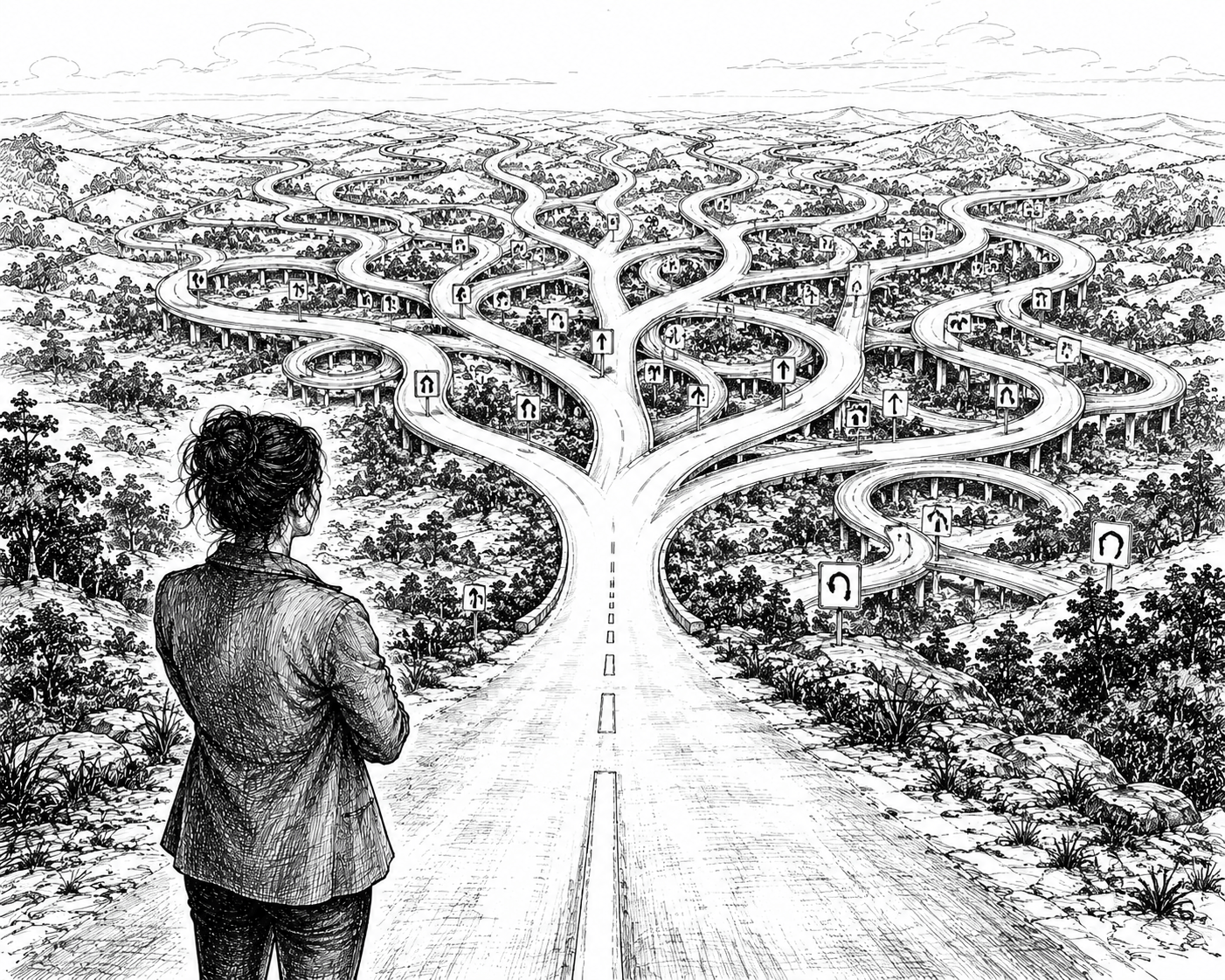
The Future is Many Possibilities
Prediction asks, “What will happen?” Foresight asks a different set of questions: What is changing? What might follow? What assumptions are beginning to weaken? And is our current understanding of the world still good enough to guide our decisions?
Frank Diana recently wrote a great article where he explains this in detail.
Prediction seeks an answer. Orientation points us in a direction and preserves the ability to revise.
That distinction matters because the future rarely announces itself through one decisive fact. More often, it appears gradually through weak signals, anomalies, changing relationships, unexpected combinations, new behaviors, and shifts in what people value. Leaders must assemble these fragments into a working understanding of what may be emerging without pretending that the picture is complete.
The purpose of foresight, then, is not to eliminate uncertainty. It is to keep an organization close enough to changing conditions that it can recognize when its assumptions are failing and still has time to respond.
An oriented organization can admit that a trusted model is weakening. It can prepare before proof is complete, preserve options while several futures remain plausible, and change direction without treating revision as institutional failure. Its strength does not come from always being right. It comes from remaining capable of learning.
This is where foresight becomes especially important for leadership. Organizations naturally seek coherence. They develop strategies, narratives, assumptions, processes, and explanations that help people understand what the organization is doing and why. That internal coherence is necessary, but it can also become dangerous when protecting the institutional story becomes more important than maintaining contact with external reality.
Organizations begin to drift when they defend yesterday’s explanation of the world against today’s evidence.
Foresight helps restore the balance. It keeps the institutional story open to correction by the world it is meant to explain. It encourages leaders to ask not only whether their strategy is being executed well, but whether the assumptions underneath that strategy still deserve to be trusted.
That requires more than analytical technique. Scenarios, signals, trend analysis, and forecasting tools can help leaders see change, but tools cannot guarantee that leaders will accept what they see. Emerging reality may threaten an investment, a strategy, a promise, a reputation, or an identity. At that moment, foresight becomes a test of character as much as intelligence.
Leaders must be willing to remain honest when evidence becomes uncomfortable, receptive when established beliefs are challenged, steady when certainty disappears, and responsible when new information requires a change of course.
The real value of foresight is therefore not that it allows us to see the future with certainty. It is that it helps us remain oriented while the future is becoming the present.
Discover more from The Future - With Kevin Benedict
Subscribe to get the latest posts sent to your email.